Of all the work I have done this semester I believe the following three assignments represent my growing flexibility as a writer and my improving understanding of different rhetorical situations. At the beginning of the semester I hoped to grow in the areas of metacognition and clarity. These three pieces are the best examples of my adapting tone, perspective, and style to fit each situation at hand.
1. A Literacy Narrative
http://badgerdesk.blogspot.com/2012/10/a-literacy-narrative-or-when-baby.html
For this piece the audience was difficult to pinpoint, but treating it as a personal article to a general viewership helped its form. The media included went through numerous edits and I had to continuously ask myself: how much is too much? What adds to the story and what is just clutter? This is the closest to the writing I normally do and as the first assignment of the class it serves as one of my most subtly improved writings.
2. An Editorial
http://badgerdesk.blogspot.com/2012/11/yahweh-goes-to-washington.html
Taking a stance, being controversial, and being persuasive without alienating your audience can be tricky, but it is also incredibly fun. In this editorial I attempted to blend humor, opinion, and facts to paint a clear picture on an issue I feel strongly about. I also feel that the title of this piece is particularly effective and could stand out amongst other headlines on a newspaper or journal website. I am not always able to mince my words, but each one was worth its weight in "Yahweh Goes to Washington."
3. An Evaluation
http://badgerdesk.blogspot.com/2012/11/college-dine-ins-and-dives.html
Like the editorial, this restaurant review was fun because it is all about opinion. I was even more aware of audience for this piece because of my own inclusion in that audience. College students on a shoe-string budget need an honest, concise, and persuasive opinion on the eateries in their area. As one of the later assignments from this semester, this evaluation showcases the best of what I have learned about rhetorical situations, brevity, and clarity.
Tuesday, December 4, 2012

A Look Back
We've covered a variety of rhetorical situations in Advanced Writing this semester and this post will discuss two of those situations (as covered in Units 2 and 5).
 Unit 2 was interesting because it made me reevaluate the kinds of writing I do on a daily basis. I don't usually stop to consider if my e-mail is as short (but still informative) as it can be before I send it yet that is what Unit 2 opened my eyes to. No one wants to wade through a short novella before getting to the point each time they open an e-mail and they don't want to be left with follow up questions if they can help it. The most effective e-mails are concise and polite. Unit 2 was excellent practice towards being concise.
Unit 5 stands out from Unit 2 because resumes and cover letters aren't the kinds of writing I do everyday, but they are still incredibly important. They are also incredibly difficult for me. How does one convey one's strengths and experience on a single page without 1. being hyperbolic or 2. selling oneself short? And what exactly goes into a cover letter? These are both questions that I had before our class went through Unit 5 and I feel that now I have the answers. That doesn't mean putting together a resume or cover letter is any more fun, but at least it is less confusing.
Unit 2 was interesting because it made me reevaluate the kinds of writing I do on a daily basis. I don't usually stop to consider if my e-mail is as short (but still informative) as it can be before I send it yet that is what Unit 2 opened my eyes to. No one wants to wade through a short novella before getting to the point each time they open an e-mail and they don't want to be left with follow up questions if they can help it. The most effective e-mails are concise and polite. Unit 2 was excellent practice towards being concise.| Image from Yellowbrickroad.com |
Unit 5 stands out from Unit 2 because resumes and cover letters aren't the kinds of writing I do everyday, but they are still incredibly important. They are also incredibly difficult for me. How does one convey one's strengths and experience on a single page without 1. being hyperbolic or 2. selling oneself short? And what exactly goes into a cover letter? These are both questions that I had before our class went through Unit 5 and I feel that now I have the answers. That doesn't mean putting together a resume or cover letter is any more fun, but at least it is less confusing.
Tuesday, November 6, 2012
College Dine-ins and Dives (Draft)
Bamboo Bistro
Overall a pleasant, but not particularly unique dining experience.

Bamboo is a spacious Japanese steak house and sushi bar that has recently replaced the American Cafe (which quietly closed a few months back). The decor is a mix of modern and traditional -- traditional textures in modern style. Black woven booths and artistic koi posters exist in harmony with the sushi cart/bar that stands in the center of the restaurant. Unfortunately the uniqueness of Bamboo's interior does not translate to its cuisine.
The three stand-outs of our suite-mate dinner date were the crab wontons (recommended by our waitress), the seaweed salad, and the exceptional sushi. The crab was tender and creamy with a perfectly fried casing that paired great with the sweet and sour dipping sauce. Those adventurous enough to try the seaweed salad will be wowed by its subtle flavor and pleasant saltiness.
The hibachi fried rice (the cheapest and only vegetarian hibachi option) was average to good. The accompanying miso soup was similarly average, but the salads were particularly crisp and sweet. The hibachi meals climbed upwards of twenty five dollars and (if you're not a fan of sushi) that is almost your only option. Unless, of course, you want to spring for the seared steak, filet mignon, or lobster special ($20, $22, and $26 respectively).
While not the best lunch location, Bamboo Bistro could make for a great Friday or Saturday night hang-out. Their profile on Urban Spoon mentions live music and there are numerous daily drink deals. Bamboo also has plenty of space for large parties (and accepts reservations), but beware the 18% gratuity charged for groups with eight people or more.
Food: 7/10
Cost: 6/10
Atmosphere: 8/10
Service: 8/10
Overall a pleasant, but not particularly unique dining experience.
Bamboo is a spacious Japanese steak house and sushi bar that has recently replaced the American Cafe (which quietly closed a few months back). The decor is a mix of modern and traditional -- traditional textures in modern style. Black woven booths and artistic koi posters exist in harmony with the sushi cart/bar that stands in the center of the restaurant. Unfortunately the uniqueness of Bamboo's interior does not translate to its cuisine.
The three stand-outs of our suite-mate dinner date were the crab wontons (recommended by our waitress), the seaweed salad, and the exceptional sushi. The crab was tender and creamy with a perfectly fried casing that paired great with the sweet and sour dipping sauce. Those adventurous enough to try the seaweed salad will be wowed by its subtle flavor and pleasant saltiness.
The hibachi fried rice (the cheapest and only vegetarian hibachi option) was average to good. The accompanying miso soup was similarly average, but the salads were particularly crisp and sweet. The hibachi meals climbed upwards of twenty five dollars and (if you're not a fan of sushi) that is almost your only option. Unless, of course, you want to spring for the seared steak, filet mignon, or lobster special ($20, $22, and $26 respectively).
While not the best lunch location, Bamboo Bistro could make for a great Friday or Saturday night hang-out. Their profile on Urban Spoon mentions live music and there are numerous daily drink deals. Bamboo also has plenty of space for large parties (and accepts reservations), but beware the 18% gratuity charged for groups with eight people or more.
Food: 7/10
Cost: 6/10
Atmosphere: 8/10
Service: 8/10
Located at
3662 Airport Boulevard, Suite A
Mobile, AL 36608
Rating Guide:
Atmosphere is judged on a restaurant's decor, lighting, set-up (too spacious vs too cramped), and general pleasantness.
Service is judged on speed of food delivery, attitude of server, knowledge of server regarding menu and daily specials, whether refills were forthcoming, etc.
Cost is judged relative to the deliciousness of the food and portion size.
Food is judged on taste, appearance, and variety (including vegetarian and vegan alternatives).
Friday, November 2, 2012
To sleep, perchance to dream...
This short narrative was written for a Tudor-Stuart history assignment regarding 16th century dream interpretation.
- - - - - - - - - - - - - - - -
Margaret, called Mags, wakes in the night slick with the cold sweat of fear. All around her the other kitchen girls are sleeping heavily from the last day’s labor, but Mags hardly sees them. Even open-eyed she still sees the silent woman of her night terror, a woman with bloody colored eyes staring out at the moon. Mags crawls away from her bedmates and pulls on her slippers. She’ll go up to the kitchen, where it’s warm, and forget all about somber, frightening figures in lonely towers.
Tom, who tends the stables, and Cook (also named Margaret) are on stools by the kitchen fire. Tom is scraping his boots clean while Cook scrubs at a soup pot. They both look up at the sound of her footsteps and startle at the waxy look of fear still on her face. “Come sit, girl, what’s the matter?”
“Just a dream, but the worst I’ve ever had I think.” Mags forgoes a stool and sits shakily on the warm stones of the hearth. It’ll dirty her dress for sure, but Cook (who’s left her pot and is busying with a pitcher and cup) will forgive it of her.
“Dreamt about a husband did you? Frightening old man who made you scrub the floors in your wedding lace?” Tom’s teasing is usually enough to bring a flush to Mags’ cheeks, but it does nothing for the cold in her now. “Silent king maybe? He means a frightening husband as well, you know.”
“No,” Mags whispers. There had been no men in her dream. “There was a woman sitting on the stair-a fine lady-in gold and pearls and,” Mags scoots farther onto the hearth, closer to the fire burning bright and hot, “and a crown.”
Tom whistles lowly. “Bad luck, that.”
“Don’t fill her head with your foolery,” Cook scolds.
“It’s true, ain’t it?” Tom flicks a bit of mud into the rushes and scrapes his knife along his thigh. “A queen speaking to you in dreams means a bad turn’s about. Liars, turncoats, treachery.”
“She didn’t say nothin’ though.” Mags shivers at the memory of the queen. A fine golden woman with wine red eyes staring out at the sky. “She was just looking at the moon.”
Tom hums, like a learned astrologer or some such, and considers Cook’s questions. “A silent queen could mean good luck and so does a clear moon. Was it a fair place, your tower?”
“No, but it wasn’t bad neither. Just empty I suppose. We were the only one’s there.” Mags drinks deeply from her mug, hoping for some courage hidden at the bottom of the cup.
“Not too much now,” Cook tuts, “Or else you’ll have bad dreams a plenty.”
“Your queen’s pearls --well those are tears-- but the moon was fine you say? Stayed up in the sky and all that?”
“I’m not sure, I didn’t look long.” Tom and Mags sit in silence. Tom thinking of falling moons and dead noble women and Mags thinking she’d rather dream of a terrible old husband who made her scrub the floors all day.
“That’s enough of you two, I think.” Cook tells them, taking Mags’s empty mug. “Off to bed with you both. I haven’t any diamonds to take with you so your frights will have to stay.”
Yahweh Goes to Washington
This is an editorial written for my Advanced Writing class.
Warning: Divisive opinion ahead.
Warning: Divisive opinion ahead.
| Senate candidate Richard Mourdock: Male expert on women's rights. |
Indiana’s Republican Senate candidate Richard Mourdock stunned and disgusted many when he stated that pregnancies resulting from rape are “something that God intended to happen.” Now one could argue over the theological inferences that statement leads to (namely, God intends for rape to happen), but I ask instead: why does it matter? Thomas Jefferson believed religion to be a personal matter that must necessarily be separated from the affairs of the state. In a now famous letter written to the Danbury Baptist Association, Jefferson stated there must be a “wall of separation between church and state.” So how is it that government officials come to speak so openly and vigorously about God (and it is always God) in debates?
The wall Jefferson spoke of is no iron curtain; it could now be likened to an old bedsheet – flimsy, easily twisted, and even more easily cast aside. As the election looms this bedsheet is being battered from both sides. The Roman Catholic Church is on one side and members of congress on the other. In a coincidence as stunning as Mourdock’s rape comments, both sides are fighting over God’s place in women’s health care.
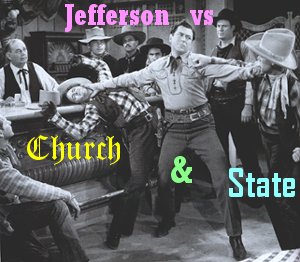 The Church sees President Obama’s new employee health insurance regulations as blatant attack on their constitutional rights. Chief amongst their complaints is the requirement to provide women the option of birth control, so called “morning after” pills, and sterilization. Failure to comply (though the President has extended the deadline) will result in fines levied against the organization. Church officials are calling this a violation of their religious liberties and their religious conscience. They disagree that hiring employees outside of the church should subject them to the laws governing those people and they most stringently disagree with contraception legislature. This reveals a rather gaping disconnect between the church and its flock because these employees aren’t just heathen non-believers seeking a way to avoid the consequences of their carnal desires. 98% of sexually active Catholic women in the United States use birth control. And President Obama’s regulations in no way force Catholic organization employees to use contraception, only that the option and access be provided.
Opposition on the other side of the bedsheet is lead primarily by GOP congressman whose war on women’s health care has waged long and hard. Abortions are an abomination, they say. Life is a gift from God, they say. Life begins at conception, they say. You must all be subject to our religious interpretation of birth, they don’t say, but it is what they mean. And it shouldn’t matter. Rick Santorum has said the separation of church and state disgusts him. Presidential candidate Mitt Romney thinks the separation of church and state has been taken “well beyond its original meaning.” Both fail to see that Jefferson’s wall is practically nonexistent.

I am reminded of my time in high school and the debate sparked by my US Government teacher. “What do we think about the thought for the day?” He asked us. The thought for the day broadcast every morning over the school speakers was invariably a quote from scripture. My high school was (and still is) a public institution. I raised my hand and said I believed it to be a violation of the First Amendment. A girl behind me raised her hand and told me if I didn't like it then I didn't have to listen to it.
Does the same apply when it’s the law?
Tuesday, October 23, 2012
Reflection
This post is a reflection on my blogging experience as it relates to my Advanced Writing class.
 This has definitely been an interesting unit for me and an especially helpful one as well. It is much easier to see how important the details are when one is preparing for them to go online (the internet is forever!). Font, color, size, and organization are integral to every piece of writing, but it can be difficult to see past the 8"x11" paper and Times New Roman sometimes.
This unit spread everything out. The unique format also made it easier to take myself out of the writer role and into that of a reader. When setting up this blog I frequently typed in the BadgerDesk address and asked myself, "Does this look right?" Is this interesting without being overpowering? Professional without being boring? Eventually I settled on what I thought to be a happy medium.
It was also easier to take my cues from other blogs in creating this one than it has been for me to use a template for other assignments. While the idea is the same (similar format, separate content) it is nonetheless something that I struggled with.
Have any of you had similar problems? How did you make the transition?
Tuesday, October 16, 2012
A Baby Badger Learns to Read
“Thank you!
Thank you,
Sam-I-Am.”
 My mother calls it “the story I’ve told you a thousand times” (which is true of any story involving me younger than age ten), but still she relishes the opportunity to tell it again. Thanksgiving, Christmas, and Easter dinners are her usual stage. Cousins who remark on bookcases full to bursting are her usual audience. But whenever I ask to hear this story, times few and far between, I receive a mere blurb. “Oh, you remember Green Eggs and Ham. I read you that book and then you read me that book.” This is the story for the cousins, the long version, the one that begins in the North Pacific Medical Hospital waiting room.
I am a four year old creature of anxiety, restless with ignorance over my sister’s aching ears and my mother’s swollen belly. A television mounted on the far wall plays static coated reruns of Designing Women and a low table surrounded by small plastic chairs offers an assortment of colorful, hopeful toys. Together the television and toys hold my attention for a generous two visits. By the third my mother is digging through the rectangular mountain of magazines and books on the end table. Riflemen and National Geographic are both rejected (for violence and nakedness, respectively) and The Babysitter’s Club is too complex and picture-less. The only book that stands up to her scrutiny is Green Eggs and Ham.
 It is orange and hard covered and I love it on sight. Every trip to see Dr. Halter begins with this book. For five months of doctor appointments I sit patiently beside my mother and she reads me the story of Sam-I-Am and the nameless narrator. We point to the words together and say them slowly, exaggerating every syllable over and over. Tabby, quiet and miserable with the familiar pain of ear infections, spends these visits lying across the waiting room chairs. I crouch on the floor near her head and slowly whisper-read my new favorite book to her. I love the fox in the box the best. She loves me too much to tell me to scram.
I am further encouraged by the easy confidence of my mother; if I could read one book, I could read any book. When the baby is fussy she sets me up with hand-me-down Hooked on Phonics tapes. My grandfather sends a book of children’s poetry for my birthday. My father stops by the convenience store on the way home from work to pick through their choice selection of children’s classics. Tabby and I watch Reading Rainbow and Between the Lions every morning over our bowls of coco pebbles. I prop my new baby sister up against my chest and balance One Fish, Two Fish on my knees so we can read it together. After my first day of school I return home crying because they were supposed to teach me how to really read and they didn’t (another of my mother’s favorites).
Fifteen years later Tabby has had her first baby -- a girl. Our first shopping trip together, we three sisters and two month old Kailynn, is to the book store. We start with Eric Carle (Tabby’s already bought Green Eggs and Ham).
 - - - -
This literacy narrative was written for my Advanced Writing class.

My mother calls it “the story I’ve told you a thousand times” (which is true of any story involving me younger than age ten), but still she relishes the opportunity to tell it again. Thanksgiving, Christmas, and Easter dinners are her usual stage. Cousins who remark on bookcases full to bursting are her usual audience. But whenever I ask to hear this story, times few and far between, I receive a mere blurb. “Oh, you remember Green Eggs and Ham. I read you that book and then you read me that book.” This is the story for the cousins, the long version, the one that begins in the North Pacific Medical Hospital waiting room.
I am a four year old creature of anxiety, restless with ignorance over my sister’s aching ears and my mother’s swollen belly. A television mounted on the far wall plays static coated reruns of Designing Women and a low table surrounded by small plastic chairs offers an assortment of colorful, hopeful toys. Together the television and toys hold my attention for a generous two visits. By the third my mother is digging through the rectangular mountain of magazines and books on the end table. Riflemen and National Geographic are both rejected (for violence and nakedness, respectively) and The Babysitter’s Club is too complex and picture-less. The only book that stands up to her scrutiny is Green Eggs and Ham.
 It is orange and hard covered and I love it on sight. Every trip to see Dr. Halter begins with this book. For five months of doctor appointments I sit patiently beside my mother and she reads me the story of Sam-I-Am and the nameless narrator. We point to the words together and say them slowly, exaggerating every syllable over and over. Tabby, quiet and miserable with the familiar pain of ear infections, spends these visits lying across the waiting room chairs. I crouch on the floor near her head and slowly whisper-read my new favorite book to her. I love the fox in the box the best. She loves me too much to tell me to scram.
I am further encouraged by the easy confidence of my mother; if I could read one book, I could read any book. When the baby is fussy she sets me up with hand-me-down Hooked on Phonics tapes. My grandfather sends a book of children’s poetry for my birthday. My father stops by the convenience store on the way home from work to pick through their choice selection of children’s classics. Tabby and I watch Reading Rainbow and Between the Lions every morning over our bowls of coco pebbles. I prop my new baby sister up against my chest and balance One Fish, Two Fish on my knees so we can read it together. After my first day of school I return home crying because they were supposed to teach me how to really read and they didn’t (another of my mother’s favorites).
Fifteen years later Tabby has had her first baby -- a girl. Our first shopping trip together, we three sisters and two month old Kailynn, is to the book store. We start with Eric Carle (Tabby’s already bought Green Eggs and Ham).

- - - -
This literacy narrative was written for my Advanced Writing class.
This literacy narrative was written for my Advanced Writing class.
Subscribe to:
Posts (Atom)